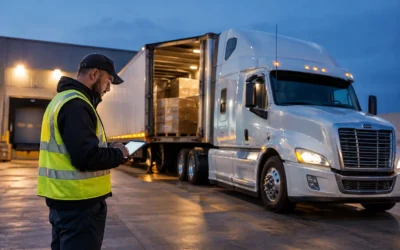
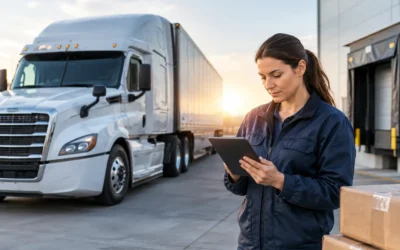
A late piece of equipment, a load that will not clear an overhead obstruction, or a trailer that cannot turn into the delivery yard can put a production schedule behind before the truck even leaves. When comparing gooseneck versus flat deck trailers, the right answer is not simply about which setup can carry more. It is about the load, the pickup site, the route, the delivery conditions, and the deadline you are protecting.
For commercial shippers, trailer selection should be part of the freight conversation from the first quote. Accurate dimensions, weight, loading method, and site access details give the carrier what it needs to assign equipment that can load safely and deliver without unnecessary delays.
First, Understand the Difference
Gooseneck and flat deck are often discussed as competing trailer types, but they describe different parts of a hauling setup. A flat deck describes an open, level freight platform. A gooseneck describes the front connection of a trailer, which extends over the bed of a compatible pickup or truck and couples in the bed rather than at a rear bumper hitch.
That means a gooseneck trailer can also have a flat deck. In day-to-day freight conversations, though, people may use “flat deck trailer” to mean a conventional flatbed pulled from a rear hitch, or a flat deck truck with a fixed deck body. The distinction matters because the hitch design affects maneuverability, weight distribution, turning behavior, and what truck is required.
Before a carrier dispatches equipment, it should confirm what is actually being compared: a gooseneck flatbed trailer, a bumper-pull flatbed, a fifth-wheel trailer, or a flat deck truck. Clear terminology avoids an incorrect quote or an unsuitable truck arriving at the pickup location.
When a Gooseneck Trailer Makes Sense
A gooseneck setup is commonly used for equipment, materials, machinery, and other freight that needs a stable connection and practical maneuverability. Because the hitch point sits over or near the rear axle of the towing vehicle, the configuration generally provides better control than a conventional bumper-pull trailer when handling substantial loads within its rated capacity.
This can be valuable at construction sites, rural properties, industrial yards, and other locations where trucks need to back into position or make tighter turns. The gooseneck also leaves the rear of the towing vehicle available in a way that can be helpful for certain operational setups.
Gooseneck equipment is often a strong fit when the shipment is urgent but not large enough to require a heavier commercial tractor-trailer configuration. It can be an efficient option for expedited equipment moves, jobsite materials, fabricated components, and specialized freight where access is as important as transit time.
Still, a gooseneck is not automatically the right choice for every open-deck load. Its usable deck length, loading angle, axle ratings, and the towing vehicle’s legal capacity all need to match the shipment. A load that fits physically may still require a different configuration because of weight distribution, securement requirements, or route restrictions.
Questions to Ask Before Booking a Gooseneck
A carrier needs more than a total shipment weight. Provide the length, width, height, and individual piece weights, especially for machinery or skidded freight. Let the dispatcher know whether the load can be driven, lifted by forklift, loaded by crane, or needs ramps.
Access details matter just as much. A narrow gate, steep driveway, soft ground, limited turnaround space, or congested jobsite can change what equipment can safely enter and exit. If pickup or delivery is time-sensitive, identify receiving hours, contact names, and any site rules before dispatch.
When a Flat Deck Is the Better Freight Tool
A flat deck is built for flexibility. Open sides and top access make it practical for freight that is too wide, long, irregular, or difficult to load through the doors of an enclosed trailer. Steel, lumber, palletized materials, crated machinery, pipe, building products, and industrial components are all common flat deck freight.
The biggest advantage is loading access. Forklifts can load from either side, cranes can place material from above, and long items can be positioned without the restrictions of an enclosed box. For shippers moving multiple pallets or awkward freight, that can reduce loading time and help keep a scheduled pickup on track.
Flat deck capacity also scales well. A smaller flat deck truck may be the right answer for an expedited regional shipment, while a heavier configuration can handle far larger industrial loads. At Hot Shot Delivery Service, fleet options range from a 5-ton flat deck truck for loads up to 15,000 pounds to Super B configurations for freight approaching 90,000 pounds, subject to the load, route, and legal requirements.
The trade-off is exposure. Freight on an open deck is exposed to weather, road spray, and shifting wind. Proper tarping, blocking, bracing, and securement are not afterthoughts. They are part of a safe shipping plan. If your freight cannot be exposed to the elements, needs side protection, or has a delivery site that cannot accommodate an open-deck truck, a curtain side or another configuration may be more suitable.
Gooseneck Versus Flat Deck Trailers: Key Decision Factors
The right equipment choice starts with the freight itself, then works outward to the loading site and route. Weight is the obvious concern, but it should never be considered alone. A compact, dense machine may create different axle and balance requirements than a longer load with the same total weight.
Length and loading method are usually the next deciding factors. A gooseneck may be ideal for a piece of mobile equipment that can be loaded by ramp and delivered to a tight site. A larger flat deck may be more efficient for multiple pallets, long materials, or freight loaded by crane. For especially tall or wide shipments, deck height and permit requirements may determine the equipment before any other factor.
Delivery access can change the decision at the last mile. A full-size flat deck may carry the load efficiently on the highway but lack room to turn at the final destination. Conversely, selecting a smaller configuration simply because it can access a site may not work if the weight or dimensions exceed its safe operating limits. This is where experienced dispatch planning saves time.
Timing also matters. When a production line needs a replacement part or a construction crew is waiting on material, the fastest option is the one that can load, travel, and unload without a preventable complication. That means matching the equipment to the job at the beginning, not finding out at pickup that the freight needs a different deck, additional securement, or a larger truck.
Do Not Choose by Price Alone
A lower transport price can look attractive until a poorly matched trailer creates a missed loading appointment, a second truck dispatch, or a delivery refusal. The goal is not to book the smallest or least expensive equipment on paper. The goal is to move the freight safely, legally, and on schedule with the right capacity available.
A useful quote request includes the pickup and delivery locations, ready time, required delivery time, commodity, piece count, dimensions, total weight, and how the freight will be loaded and unloaded. Photos are often helpful for machinery, unusual shapes, or site constraints. The more complete the information, the more confidently a carrier can recommend a gooseneck, flat deck, curtain side, tridem, or heavier configuration.
For regular lanes, it also helps to share the operational reason behind the shipment. Is this stock replenishment, a jobsite delivery, a plant shutdown, or a customer commitment? A carrier that understands the deadline can plan around the consequences of delay rather than treating the load as a generic pickup.
Match the Trailer to the Work Ahead
Gooseneck equipment is a practical choice when maneuverability, controlled towing, and smaller-to-midrange equipment moves are central to the job. Flat decks are often the stronger choice when open loading access, larger freight, long materials, or heavier capacity are required. In many cases, the real choice is not gooseneck or flat deck at all. It is a gooseneck flat deck versus a larger commercial flat deck configuration.
When your shipment has a tight window, send the dimensions, weight, loading details, and site information with your quote request. The right trailer is the one that arrives prepared, protects the load, and keeps your operation moving.