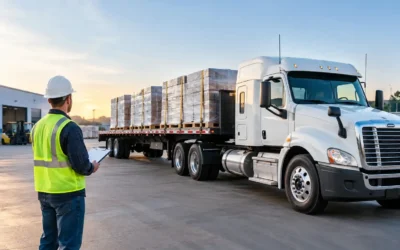
A load can fit within the weight limit and still be the wrong freight for a standard trailer. Height under bridges, loading access, machine clearance, tie-down locations, and the delivery site all affect the decision. When comparing flat deck versus step deck, the right choice starts with the freight itself – then the route, timing, and equipment needed to move it safely.
For commercial shippers, this is not just a trailer preference. Choosing the proper deck can prevent permit delays, reloading costs, site-access problems, and missed production deadlines. A carrier should review the full shipment before dispatching a truck: length, width, height, weight, center of gravity, pickup method, delivery conditions, and required arrival time.
Flat Deck Versus Step Deck: The Core Difference
A flat deck has one continuous, level deck from front to back. It is a practical choice for freight that can be loaded from the side, top, or rear and does not create an excessive overall height when placed on the deck. Steel, building materials, crated products, pipe, fabricated components, and many types of industrial freight move efficiently on a flat deck.
A step deck, also called a drop deck, has two deck levels. The front section sits higher above the ground, while the main lower deck begins behind the tractor. That lower section gives taller freight more room below height restrictions without changing the load itself.
The question is not whether one trailer is better than the other. A flat deck is often simpler and more versatile for standard open-deck freight. A step deck becomes valuable when equipment or materials are too tall to ride on a flat deck while remaining within allowable travel height. The difference can determine whether a load moves directly or requires a different route, special permit, escort, or costly adjustment.
When a Flat Deck Is the Better Fit
Flat decks are built for straightforward loading and dependable transport of freight that is dimensionally manageable. With a level platform, they are especially useful where a forklift needs consistent access along the trailer or where freight is loaded in multiple positions. They also work well for long materials that need continuous support beneath them.
For many manufacturers, construction suppliers, and distributors, a flat deck is the first choice because it keeps the operation simple. A shipment of bundled steel, lumber, pallets of materials, structural components, or properly crated machinery may load quickly and secure efficiently on a level deck. If the freight remains within legal height and weight requirements, there may be no reason to introduce the added planning of a lower-deck configuration.
A flat deck can also be the better option when delivery conditions matter. Some job sites, yards, and receiving docks have uneven approaches, tight turns, or ground clearance concerns. Trailer selection needs to account for the entire trip, including whether the equipment can safely enter and exit the final site.
That said, a standard deck height adds to the height of anything placed on it. Tall machinery, tanks, preassembled modules, and some construction equipment can quickly become an overheight load. Measuring from the ground to the highest fixed point is essential. Guessing from a product specification sheet is not enough when a shipment needs to meet a tight delivery window.
When a Step Deck Solves the Problem
A step deck is often the practical answer for freight that is tall, heavy, or awkward to load but does not require a specialized lowboy. Its lower main deck reduces the overall loaded height, giving shippers more clearance for equipment such as lifts, compressors, excavator attachments, industrial skids, tanks, and fabricated assemblies.
The lower deck may also make loading easier for certain wheeled equipment. Depending on the trailer configuration and the freight, equipment can be driven or loaded onto the lower section with appropriate ramps and securement planning. This can reduce handling steps at the pickup point and help protect equipment that should not be lifted unnecessarily.
A step deck does involve trade-offs. The usable lower-deck length may be different from the full length of a flat deck, and the raised front section changes how freight can be positioned. For long, rigid, or unusually shaped loads, the carrier must confirm where the weight will sit and whether the freight can be supported correctly. The lowest deck is helpful, but it is not automatically the right deck for every tall shipment.
Clearance is another operational consideration. A step deck sits lower to the road, which benefits overall load height but can require extra attention at steep entrances, uneven yards, rail crossings, and rough job sites. The carrier should know what conditions are waiting at both ends of the trip before assigning equipment.
Dimensions Are Only Part of the Decision
Shippers commonly begin with dimensions, and they should. Provide the exact length, width, height, and total weight of the freight. But accurate deck selection requires more detail than four numbers.
A production machine may be tall but have a narrow, concentrated center of gravity. A steel assembly may be within standard dimensions but require specific blocking to prevent movement. A piece of equipment may have a low loading point, delicate components, or tie-down restrictions set by the manufacturer. These details affect how the load is secured and where it can safely sit on the trailer.
Weight distribution matters just as much as gross weight. A shipment can be below a trailer’s stated capacity and still be unsuitable if too much weight is concentrated in one area. Axle limits, deck rating, securement points, and the truck configuration all need to be considered before pickup.
Route planning also belongs in the conversation early. A load that works on one highway route may face restrictions on another. Road construction, seasonal conditions, bridge clearances, access roads, and municipal delivery requirements can change the plan. For urgent freight, discovering a routing issue after the truck arrives is the kind of delay that can affect an entire production schedule.
Get the Load Details Right Before Requesting a Quote
The fastest way to get an accurate freight quote is to send complete, verified shipment information from the start. Include the pickup and delivery locations, ready time, required delivery time, commodity description, dimensions, weight, and loading equipment available at each end. Photos are useful for unusual machinery, fabricated items, or loads with irregular shapes.
It also helps to explain how the freight will be loaded and unloaded. Is a forklift available? Is a crane scheduled? Can the product be loaded from the side, or does it need rear access? Will the delivery site have room for the truck to turn around? A few clear details before dispatch can prevent a driver from arriving with a trailer that does not match the job.
If the shipment is near a height or weight threshold, do not wait until pickup day to raise the concern. Ask for the load to be reviewed for the appropriate deck, securement needs, and route requirements. That is particularly important for time-sensitive equipment moves, construction deliveries, and material shipments supporting active crews.
Reliable Freight Planning Starts Before the Truck Arrives
The best flat deck versus step deck decision is made before freight is loaded, not when a driver reaches the yard. A careful review protects the shipment, keeps the truck moving, and gives your receiving team a more dependable delivery time.
Hot Shot Delivery Service works with commercial shippers across British Columbia and select Alberta routes to match urgent and scheduled freight with the right truck configuration. For equipment, materials, machinery, and industrial loads, provide the full shipment details and required timing. A reviewed quote gives you a clear transport plan before the load leaves the ground.
When production is waiting on a part, materials are needed on site, or equipment has to arrive for the next shift, the right deck choice helps keep the job on schedule.